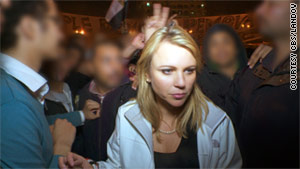
CBS teporter Lara Logan covers a demonstration in Cairo's Tahrir Square in February, 2011. She was sexually assaulted moments later. See http://lat.ms/wJOf3v for the story.
Washington Post national political correspondent and former Time reporter Karen Tumulty noted today on Twitter that sleeves have gone out of style for female news anchors.
I’ve noticed that what is in style is:
· Cleavage and lots of it
· Beach-wear worn year round, anywhere, anytime
· Loose long hair
· Dangling earrings
· Lots of makeup accentuating heavy-lidded eyes and pouty lips
I see this not only with news anchors but with reporters, even some working in extremely conservative Muslim environments or at the White House.
Why is this happening?
At a time when women benefit from hard-won rights (and when there’s still plenty to do in that department), why would smart women choose to look so tarty on the job? Is it a political statement? Do they really believe they should always flaunt sexuality, wherever they are and whatever they are doing? Do they accentuate their curves to de-emphasize their intelligence and professional accomplishment?
I suspect this trend originated with media bean counters who saw a chance to boost ratings among viewers with short attentions spans and little interest in depth, by putting entertainment first, hard news last. The idea is to make news programs look more like Entertainment Tonight and less like The News Hour.
Hence, the de riguer, on-the-job outfit for a female reporter is something more appropriate for a cocktail party than a business meeting, even if the woman wearing it has a couple of college degrees, years of experience in a tough business and is hard at work, not partying.
Just to clarify, I’m not blaming Lara Logan for the behavior of the men who attacked her in Tahrir Square. Any man, from any culture, should be held responsible and condemned for physically overpowering and/or sexually assaulting a woman. Rape, even attempted rape, is a violent act that hides behind the pretense of sex.
By our standards, Logan's appearance was fairly prim, but if you saw her through the eyes of someone living in an Islamic culture, you might think otherwise. Muslim men are not accustomed to seeing women display their hair and skin in public. It was apparent, even to the most casual viewer watching Logan's live news report, that the men surrounding her were aroused. Frankly, I was not shocked when I learned of the attack.
In journalism school, wannabe reporters learn how to be a fly on the wall. When in Rome, etc. If you're covering a battle, keep your head down and wear a flak jacket. In the presence of the Pope, choose something modest, clean and neat. In a Muslim nation, try to blend in with other professionals. In other words, don't ignore the standards of the culture in which you are reporting, in favor of the culture you are reporting for.
So, Lara Logan went to cover a battle dressed for a casual date. And under the lights of the camera, she bared her gorgeous and exotic blond hair, a hint of cleavage and make up appropriate for video. I don't think her appearance would have been a problem on an ordinary day for an ordinary story coming out of London, LA or New York.
But this was Egypt. She was reporting live from the middle of a frenzied mob during a revolution. Put a couple of hundred thousand men turned on by social upheaval, lock them into a contained space, add (even a small) a dose of sexual arousal and you have a recipe for disaster.
I'm betting this mob could have assaulted anyone, male or female, especially if they saw that person exuding sex appeal at this inappropriate time in such an inappropriate setting. Again, I blame the bean counters, the media marketers, the producers who were not looking out for her best interests in such a volatile and hostile situation. It took a woman in a burqa to save her, and that says it all.
Below are portions of a transcript from the 60 Minutes segment in which Logan describes her horrific ordeal. They are quoted in Show Tracker, a Los Angeles Times blog. For the complete story, go to the Times at http://lat.ms/wJOf3v:
Breaking a months-long silence, CBS war correspondent Lara Logan talked to "60 Minutes" on Sunday night about what really happened to her in Cairo's Tahrir Square. On the night of Feb. 11, as the dictatorship of Hosni Mubarak was falling, Logan joined the more than 100,000 people celebrating in the square, where she says a mob turned on her and sexually assaulted her.
"Suddenly, before I even know what's happening, I feel hands grabbing my breasts, grabbing my crotch, grabbing me from behind," she told Scott Pelley of "60 Minutes."
Things quickly spiraled out of control. "I think my shirt, my sweater was torn off completely," she said. "My shirt was around my neck. I felt the moment that my bra tore. ... And I felt them tear out, they literally just tore my pants to shreds. ... I didn't even know that they were beating me with flagpoles and sticks and things, because I couldn't even feel that. Because I think of the sexual assault, was all I could feel, was their hands raping me over and over and over again. ... They were tearing my body in every direction at this point, tearing my muscles. And they were trying to tear off chunks of my scalp, they had my head in different directions."
Logan said she was fighting for 25 minutes and didn't think she would live. "I was in no doubt in my mind that I was in the process of dying," she said. But thinking about her two children at home in Washington helped her focus on staying alive.
Eventually, she said, she was rescued by a woman dressed head to toe in black religious robes. "Just her eyes, I remember [I could see] just her eyes," Logan said. "She put her arms around me. And oh my God, I can't tell you what that moment was like for me. I wasn't safe yet, because the mob was still trying to get at me. But now it wasn't just about me anymore."
I’ve noticed that what is in style is:
· Cleavage and lots of it
· Beach-wear worn year round, anywhere, anytime
· Loose long hair
· Dangling earrings
· Lots of makeup accentuating heavy-lidded eyes and pouty lips
I see this not only with news anchors but with reporters, even some working in extremely conservative Muslim environments or at the White House.
Why is this happening?
At a time when women benefit from hard-won rights (and when there’s still plenty to do in that department), why would smart women choose to look so tarty on the job? Is it a political statement? Do they really believe they should always flaunt sexuality, wherever they are and whatever they are doing? Do they accentuate their curves to de-emphasize their intelligence and professional accomplishment?
I suspect this trend originated with media bean counters who saw a chance to boost ratings among viewers with short attentions spans and little interest in depth, by putting entertainment first, hard news last. The idea is to make news programs look more like Entertainment Tonight and less like The News Hour.
Hence, the de riguer, on-the-job outfit for a female reporter is something more appropriate for a cocktail party than a business meeting, even if the woman wearing it has a couple of college degrees, years of experience in a tough business and is hard at work, not partying.
Just to clarify, I’m not blaming Lara Logan for the behavior of the men who attacked her in Tahrir Square. Any man, from any culture, should be held responsible and condemned for physically overpowering and/or sexually assaulting a woman. Rape, even attempted rape, is a violent act that hides behind the pretense of sex.
By our standards, Logan's appearance was fairly prim, but if you saw her through the eyes of someone living in an Islamic culture, you might think otherwise. Muslim men are not accustomed to seeing women display their hair and skin in public. It was apparent, even to the most casual viewer watching Logan's live news report, that the men surrounding her were aroused. Frankly, I was not shocked when I learned of the attack.
In journalism school, wannabe reporters learn how to be a fly on the wall. When in Rome, etc. If you're covering a battle, keep your head down and wear a flak jacket. In the presence of the Pope, choose something modest, clean and neat. In a Muslim nation, try to blend in with other professionals. In other words, don't ignore the standards of the culture in which you are reporting, in favor of the culture you are reporting for.
So, Lara Logan went to cover a battle dressed for a casual date. And under the lights of the camera, she bared her gorgeous and exotic blond hair, a hint of cleavage and make up appropriate for video. I don't think her appearance would have been a problem on an ordinary day for an ordinary story coming out of London, LA or New York.
But this was Egypt. She was reporting live from the middle of a frenzied mob during a revolution. Put a couple of hundred thousand men turned on by social upheaval, lock them into a contained space, add (even a small) a dose of sexual arousal and you have a recipe for disaster.
I'm betting this mob could have assaulted anyone, male or female, especially if they saw that person exuding sex appeal at this inappropriate time in such an inappropriate setting. Again, I blame the bean counters, the media marketers, the producers who were not looking out for her best interests in such a volatile and hostile situation. It took a woman in a burqa to save her, and that says it all.
Below are portions of a transcript from the 60 Minutes segment in which Logan describes her horrific ordeal. They are quoted in Show Tracker, a Los Angeles Times blog. For the complete story, go to the Times at http://lat.ms/wJOf3v:
Breaking a months-long silence, CBS war correspondent Lara Logan talked to "60 Minutes" on Sunday night about what really happened to her in Cairo's Tahrir Square. On the night of Feb. 11, as the dictatorship of Hosni Mubarak was falling, Logan joined the more than 100,000 people celebrating in the square, where she says a mob turned on her and sexually assaulted her.
"Suddenly, before I even know what's happening, I feel hands grabbing my breasts, grabbing my crotch, grabbing me from behind," she told Scott Pelley of "60 Minutes."
Things quickly spiraled out of control. "I think my shirt, my sweater was torn off completely," she said. "My shirt was around my neck. I felt the moment that my bra tore. ... And I felt them tear out, they literally just tore my pants to shreds. ... I didn't even know that they were beating me with flagpoles and sticks and things, because I couldn't even feel that. Because I think of the sexual assault, was all I could feel, was their hands raping me over and over and over again. ... They were tearing my body in every direction at this point, tearing my muscles. And they were trying to tear off chunks of my scalp, they had my head in different directions."
Logan said she was fighting for 25 minutes and didn't think she would live. "I was in no doubt in my mind that I was in the process of dying," she said. But thinking about her two children at home in Washington helped her focus on staying alive.
Eventually, she said, she was rescued by a woman dressed head to toe in black religious robes. "Just her eyes, I remember [I could see] just her eyes," Logan said. "She put her arms around me. And oh my God, I can't tell you what that moment was like for me. I wasn't safe yet, because the mob was still trying to get at me. But now it wasn't just about me anymore."