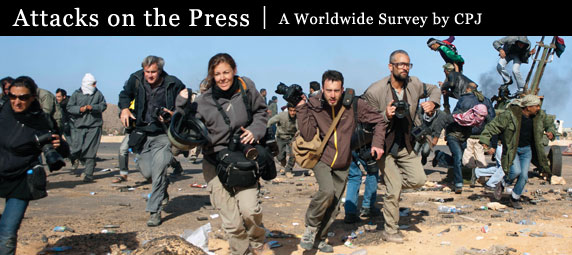
Photo from the cover of Attacks on the Press in 2011: A Worldwide Survey by CPJ
In a recent post about reporters, dress and culture (see Covering the News, But Not Much Else), I talked about Lara Logan and her near miss with death in a riot in Cairo, Egypt last year. Logan was lucky to survive, and might not have if a woman in the crowd had not come forward to protect her.
Not all reporters in dangerous situations are as lucky.
We are barely into the new year but, since the first of January, 18 journalists have been killed on the job, somewhere. Eleven of those deaths are confirmed as work-related, but seven are yet to be confirmed. Seven of the confirmed deaths occurred in Syria, with one each in Somalia, Nigeria, Thailand, Brazil and Pakistan.
I should note that these numbers do not reflect death by accident or illness, unless a “crash was caused by aggressive human action." The death of New York Times reporter Anthony Shadid, for example, is not counted among them. He died from asthma, while covering aerial attacks on the city of Homs, Syria. (See http://nyti.ms/z61XiK)
According to the Committee to Protect Journalists, 904 journalists have been killed on the job worldwide in the last 20 years, and 179 are currently in prison for the crime of doing their job.
The CPJ keeps track of journalists killed on duty “as part of its mission of defending press freedom worldwide.”
Reporters and those who facilitate the gathering and delivery of news have always faced danger, often head on. In fact, in the news world, the more dangerous the assignment, the more coveted the job. Only the best (or the most dispensable) are chosen. if you can get assigned to combat anywhere, you are all but guaranteed your pick of assignments when you get back, if you get back.
In recent years, war reporting catapulted some familiar television journalists into anchor desks. At least, that was the case for Dan Rather, Peter Jennings, Wolf Blitzer and Christiane Amanpour. Then there’s Bob Woodruff of ABC News, who replaced Peter Jennings as anchor, but one month into his assignment was hit by an IED in Iraq. Fortunately, Woodruff is back on the job, but in New York.
For more on risks involved in gathering news, go to the CPJ page at
http://bit.ly/yt3GCU
UPDATE: March 3, 2012 See below for news of journalists killed and injured in Syria. http://wapo.st/w3GoW2
Not all reporters in dangerous situations are as lucky.
We are barely into the new year but, since the first of January, 18 journalists have been killed on the job, somewhere. Eleven of those deaths are confirmed as work-related, but seven are yet to be confirmed. Seven of the confirmed deaths occurred in Syria, with one each in Somalia, Nigeria, Thailand, Brazil and Pakistan.
I should note that these numbers do not reflect death by accident or illness, unless a “crash was caused by aggressive human action." The death of New York Times reporter Anthony Shadid, for example, is not counted among them. He died from asthma, while covering aerial attacks on the city of Homs, Syria. (See http://nyti.ms/z61XiK)
According to the Committee to Protect Journalists, 904 journalists have been killed on the job worldwide in the last 20 years, and 179 are currently in prison for the crime of doing their job.
The CPJ keeps track of journalists killed on duty “as part of its mission of defending press freedom worldwide.”
Reporters and those who facilitate the gathering and delivery of news have always faced danger, often head on. In fact, in the news world, the more dangerous the assignment, the more coveted the job. Only the best (or the most dispensable) are chosen. if you can get assigned to combat anywhere, you are all but guaranteed your pick of assignments when you get back, if you get back.
In recent years, war reporting catapulted some familiar television journalists into anchor desks. At least, that was the case for Dan Rather, Peter Jennings, Wolf Blitzer and Christiane Amanpour. Then there’s Bob Woodruff of ABC News, who replaced Peter Jennings as anchor, but one month into his assignment was hit by an IED in Iraq. Fortunately, Woodruff is back on the job, but in New York.
For more on risks involved in gathering news, go to the CPJ page at
http://bit.ly/yt3GCU
UPDATE: March 3, 2012 See below for news of journalists killed and injured in Syria. http://wapo.st/w3GoW2