birdsonawire
  • Blog
  • Chirps
  • About
  • Contact
The Fall of the Berlin Wall, Part I: Introduction 11/07/2009
3 Comments
 
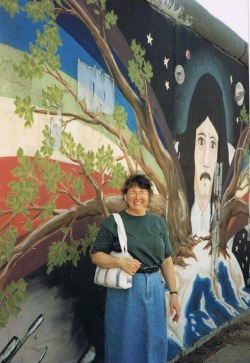
In reverse blogging order, you’ll find seven separate posts below tracing the rise and fall of the Berlin Wall. This is a pet project of mine, one that surely has stretched my blogging skills if not my research abilities and patience compiling a zillion elements.  

Sources for the material include The New York Times, BBC, London Times, Spiegel TV, Wikipedia (only footnoted and approved sections), archival material and books I picked up in Berlin and Leipzig on a trip to Germany not long after the fall. Photos are mine unless noted. Video is from YouTube, and I’ve cited the source when I could locate it. Don't miss the last one. It will blow you away.

I invite your comments, reflections and memories of Europe before, during and after the division. As for Germany, it was officially reunified on October 3, 1990. 
Picture
You already know how this story ends, so I’m going to put up some stunning video of the last minutes of the fall of the Berlin Wall, now, while you’re reading the intro.

This video was taken on November 9 and 10, 1989 by Spiegel TV, and its value will be much more evident once you’ve read the posts below. 

3 Comments
 
The Fall of the Berlin Wall, Part 2: The 20th Anniversary 11/07/2009
0 Comments
 
On November 9, 2009, Berlin will celebrate the 20th anniversary of the fall of the Berlin Wall. Over one thousand 8-foot high tiles will be stacked along the route the wall followed, and, with much fanfare, they will be toppled like dominoes. 

Daniel Barenboim will conduct the Berlin Philharmonic in a special concert, as one of many celebrations that will mark the event in Germany and around the world. 

Commemorations began last week in the US with a visit from German Chancellor Angela Merkel, who spoke before an historic joint session of Congress on Tuesday, November 3, the first German leader to do so since Konrad Adenauer in 1957. 

See http://www.nytimes.com/2009/11/06/world/europe/06merkel.html for Merkel’s remembrances of the night the wall came down. 

On the 9th, Merkel, Mikhail Gorbachev and Lech Walesa will walk together to the Bornholmer Bridge, where the first crossing was made. Their gesture will be purely symbolic, but the anniversary would be unthinkable without it, according to http://www.independent.co.uk/news/world/europe/a-bridge-opened-ndash-and-then-the-wall-fell-1817277.html

France will mark the occasion with an open-air concert and laser show held on the Place de la Concorde. According to The New York Times, the concert features prominent cellists from each of the European Union’s 27 member nations in a piece inspired by a musical tribute given at Checkpoint Charlie two days after its fall by cellist Mstislav Rostropovich. 

See http://www.nytimes.com/2009/11/04/world/europe/04parisberlin.html?ref=europe for more information. 

Through a program called Maurreise, or Journey of the Wall, symbolic wall bricks have been sent to artists in Korea, Cyprus, Yemen, among other divided countries. Artists have been asked to incorporate these bricks into works expressing the pain of people separated by impenetrable borders.  
Here's a link to the German Embassy in Washington DC, containing updates on No Man's Land, comments by German citizens who lived through the event, and much more:
http://www.germany.info/Vertretung/usa/en/10__Press__Facts/03__Infocus/04__Without__Walls/__Main__S.html

Also, see Arts and Letters Daily (www.aldaily.com) for a robust list of events, and a varied collection of rememberances.

Add Comment
 
The Fall of the Berlin Wall, Part 3: Overview of the Wall 11/07/2009
0 Comments
 
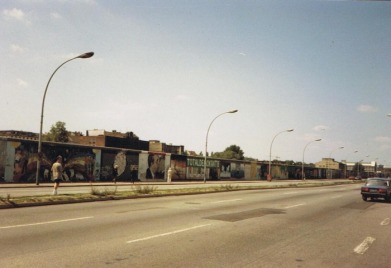
Picture
The 87-mile-long Berliner Mauer, or Berlin Wall, was erected by the German Democratic Republic (East Germany), part of the Eastern Bloc of the USSR, purportedly as an “anti-fascist protective rampart.”  

Completely surrounding West Berlin, the wall effectively sealed off a section of Germany’s largest and most important city from the rest of East Germany, making it an island trapped in a country that did not govern it. Home to 2 million people, West Berlin was affiliated with—geographically, historically, ethnically and linguistically—but not legally a part of the Federal Republic of Germany (West Germany). As a result of post-war partitioning, it was essentially a city without a country. 

Collectively, the Berlin Wall and the larger border between east and west were called The Iron Curtain (in the west, at least), because they symbolized the fiercely guarded border between the democratic Western Europe and the Eastern Bloc nations associated with the USSR. 

Immediately after World War II, millions of people emigrated from Soviet-occupied Eastern European countries to the West. By 1950, the Soviets imposed restrictions, trying reduce the number of young educated professionals leaving for opportunities in West Germany, France and beyond. Nearly 20% of East Germany’s population took part in that migration, many from the eastern to the western sectors of the partitioned city of Berlin. To stem the human tide, they put up fences and by 1961,  the fences had been turned into concrete walls.

Once the Berlin Wall and the fortified borders went up, emigration stopped and didn’t start again for almost 30 years. 

Here is how Wikipedia describes the Berlin Wall: 
The Wall included guard towers lining large concrete walls circumscribing a wide area containing anti-vehicle trenches, “fakir beds” and other defenses. 

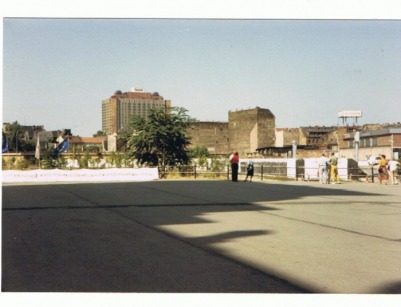
In June 1962, a second, parallel fence some 100 meters (110 yards) farther into East German territory was built. The houses contained between the fences were razed and the inhabitants relocated, establishing an area called No Man’s Land, later known as The Death Strip. The Death Strip was covered with raked gravel, easily disturbed by footprints. Guards could spot someone running the wide, open space, and had a clear shot at anyone they saw.  
Picture
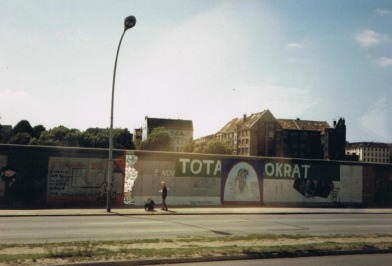
No Man's Land was paved when I saw it.

Add Comment
 
The Fall of the Berlin Wall, Part 4: Building the Wall 11/07/2009
0 Comments
 

Add Comment
 
The Fall of the Berlin Wall, Part 5: Crossings and Escapes 11/07/2009
0 Comments
 
From 1961 to 1989, eight border crossings connected East and West Berlin, allowing  Westerners into East Berlin, but very few Easterners into West Berlin. A visit on the other side required an application for a visa, with several weeks lead time, as well as a preparation fee and money left at the crossing site, as a kind of escrow. 

Perhaps Berlin’s most famous border crossing was the vehicle and pedestrian gate known as Checkpoint Charlie. That site, near the intersection of Friedrichstrasse and Zimmerstrasse, was often depicted in literature and film, especially thrillers and spy stories. 
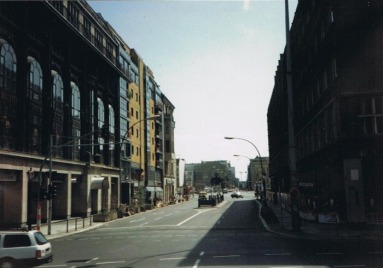
Picture
Over the course of 29 years, about 5,000 people made it across the wall, from east to west. The number of those who died trying is disputed, but thought to be between 89 and 200. There is a small, rather primitive memorial site on what was once the west side of the wall, honoring people who lost their lives trying to escape East Berlin.
Picture

Early on, when the border was made of barbed wire and other fencing, people cut through or leapt from apartment windows into the West. To prevent this, East German authorities bricked up windows in buildings near the border.

Still, people found ways to escape. They built tunnels, installed false seats in cars, even concocted hot air balloons to take them west. Some even escaped through the sewer system that ran below streets on both sides of the wall.  

The last person who didn't make it over the Berlin Wall was shot on February 2, 1989, adding to the clamor to bring it down later that year. 

Add Comment
 
The Fall of the Berlin Wall, Part 6: The US Weighs In 11/07/2009
0 Comments
 
On June 26, 1963, President John F. Kennedy visited West Berlin, reassuring residents that the US had not forgotten them, in a speech that included the memorable line, “Ich bin ein Berliner!” (True, the correct way to say "I am a citizen of Berlin" is "Ich bin Berline." Machs nicht. Everyone knew what he meant and the crowd went wild.)

Twenty-six years later, at a ceremony commemorating the 750th anniversary of the founding of the City of Berlin, President Ronald Reagan challenged Soviet Premier Mikhail Gorbachev, within earshot of guards posted at the gate and along the wall:

“If you seek peace, if you seek prosperity for the Soviet Union and eastern Europe, if you seek liberalization, come here to this gate. Mr. Gorbachev, open this gate. Mr. Gorbachev, tear down this wall!” 

Add Comment
 
The Fall of the Berlin Wall, Part 7: Die Offnung (eyewitness video on page 2) 11/07/2009
0 Comments
 
Here's a chronology of events leading to the actual collapse of the wall dividing east from west:

1980-89---Solidarity, a non-communist-controlled trade union, gains strength in Poland, elects Lech Walesa president and pushes for free elections. 

Spring 1989—The world holds its collective breath as it watches students defy tanks in Tiananmen Square. A sprit of revolt against repression is in the air.

At the same time, Protestant churches throughout East Germany use weekly prayer meetings to press for change, and prepare for peaceful demonstrations that could be mobilized quickly, when circumstances allowed. By October, they were ready. Some say the Lutheran church was East Germany’s Solidarity Party. For more on this topic, see http://www.timesonline.co.uk/tol/comment/faith/article6906779.ece

August 19, 1989---A young Hungarian border guard defies orders and allows a group of East German tourists to cross into Austria. 

See http://www.expatica.com/de/life-in-germany/news_focus/Looking-back_-Remember-the-fall-of-the-Berlin-Wall_14767.html for a recent interview with that courageous guard.  

Late August, 1989--- A Solidarity-led coalition government is elected in Poland.

September, 1989—Thousands more East Germans flee to Austria, by way of Hungary. Fearing mass defection, East German authorities demand their citizens return to Budapest, then to East Germany, immediately. Instead, thousands flood the West German embassy in Austria, seeking asylum. 

East Germany quickly stops travel to Hungary, ordering tourists already there to return home. East Germans visiting Czechoslavakia are told to return home, as well. Many refuse.  

Mass demonstrations erupt across East Germany.

October 18---Erich Honecker resigns as chancellor of East Germany. Protests grow louder and larger.

West Germany accepts those seeking asylum. Thousands more stream through Czechoslovakia, hoping to get to the West. 

The Czech government does not force East Germans to return. Chaos erupts all over Eastern Europe.

November 4—A million people gather in East Berlin’s Alexanderplatz chanting “Wir wollen raus!” or “We want out!”

November 9----Hoping to stem some of the unrest, the newly appointed East German leader agrees to loosen travel restrictions, including travel between East and West Berlin, beginning November 17. He directs Party Secretary for Propaganda Günter Schabowski to make the announcement. 

Click on Read More to see what happened next, according to New York Times reporter Alison Smale, who was in East Berlin on that historic day: 

Read More
Add Comment
 
Health care reform begins at home 11/05/2009
1 Comment
 
from  today's The Greenfield (MA) Recorder:

A role in better health
Reforms go beyond cost and care


W
e’ve heard how health-care reform will or will not work, what it will or will not cost and how it will or will not impact us as individuals. We’ve also heard from people who sincerely believe we should simply leave it alone.

But, few talk about whether reform will improve health, particularly public health.

Considering how much we spend on health insurance, gyms, organic food and vitamins, we should be a very healthy nation. Apparently, there’s room for improvement:


1. We have the highest rate of preventable deaths among (19) industrialized nations.

2. We came in 37th on the World Health Report 2000 for overall health.

3. More than half of U.S. adults are overweight.

4. Almost 2 million a year die in the U.S. from chronic, treatable diseases.

According to Assistant Secretary for Health Howard K. Koh, all five health-care reform bills before Congress contain components that “absolutely” will improve those numbers. Koh was Massachusetts health commissioner from 1997-2003. Today he is America’s top doc, overseeing the U.S. Public Health Service, the CDC, Surgeon General’s office and many related agencies.

Reform will bring quality, affordable care to most Americans, with the operative term “affordable,” since everyone will pay toward their care.

Right now, millions of Americans cannot get coverage at any cost and 14,000 more lose their insurance every day, Koh said in a recent interview. “When Americans go without health insurance, they suffer,” he added.

According to Koh, one in six Americans with employer- sponsored insurance coverage in 2006 lost it by 2008, leaving many children and adults without preventive care, immunizations, basic dental services and prescription medicine. “When sick, (the uninsured) are more likely to experience poorer health outcomes” than the insured.

Insured or not, low-income Americans — including racial and ethnic minorities as well as people living in rural areas — are less likely to receive preventive care than others.

“We are the only advanced democracy that allows this hardship on millions of its people,” according to Koh.

Once insured under reform, there will be little financial reason for anyone to go without basic health care. We will be leveling the field, reducing health disparities, in terms of access to care.

As shocking as it may seem, with reform, millions will have the opportunity to see primary-care physicians — and even dentists — for the first time. Children and adults who previously saw doctors only in emergency rooms will be screened for and, if necessary, treated for chronic diseases. And, they will be called back for check-ups.

“We’re developing a wellness care system that protects health, promotes healthy behaviors and strengthens community prevention,” Koh said.

“A national report recently found that 100,000 lives could be saved each year by investing in five basic preventive services that are available through a doctor’s office,” Koh said. “We can’t eliminate all disease, but … we can reduce chronic disease by ensuring Americans have the care they need to prevent and treat these diseases so that if they do get sick and need care, they have the best possible chance of getting better.”

To accomplish this, the 2009 Recovery Act already has pumped millions into the health-care infrastructure to build work force. Reform measures will expand on that base. Big investments in medical training should boost resources in underserved areas — such as rural New England — which otherwise might not attract enough health-care workers to make reform work.

Of course, reform really begins with each one of us. Whether health-care reform succeeds or fails, individuals will share some responsibility with physicians, hospitals and drug companies.

It won’t be painless, or easy. There are no quick fixes. And, no one will chase us around to “make us” healthy.

If we haven’t already done so, we should start to build our own healthy lives based on knowledge, responsibility and respect. It’s time to make healthy choices, as in “yes” to salads, “no” to cigarettes and binge drinking, etc. We must vaccinate our kids, encourage loved ones to exercise, make sure our young people get enough sleep and our elders are seen by doctors when they need to. We should wash our hands, flu season or not. If sick, stay out of the workplace.

In other words, we need to get our collective act together to start taking proactive responsibility for our health, because the Band-Aid approach to health care is coming to a very expensive end.

But, whatever it takes should be worth the effort, making a big difference in the lives of our children and grandchildren, by making a big difference in public health.

When it comes to closing the gap on health disparities, Koh said, “we should remember that this isn’t a partisan issue. It’s a moral issue.”

_____________________
Greenfield resident Paula Hartman Cohen writes about health care and other issues for The Recorder publications, Harvard Public Health Review, Dartmouth Medicine Magazine, and
KevinMD.com, among other media. She blogs at www.birdsonawireblog.com.


1 Comment
 
Amazing Stories: What am I doing here? Well, first I ... 11/03/2009
1 Comment
 
Now, for something completely different! I figure we all can use a good laugh.

Here’s a commercial for the French television show, Canal+, en français.  Amusez-vous!

1 Comment
 
Preview of upcoming special sections 11/03/2009
0 Comments
 
I may be a bit short on blog items in the next few days, but that’s because I’m putting together two special sections to post over the next two weeks.

Continuing to look backward in order to make sense of where we are and where we’re going, I will shift our focus to two watershed events that changed the course of our lives, and still resonate in the lives of our children and grandchildren. 

First, the fall of the Soviet Union, as exemplified by the fall of the Berlin Wall. 

November 9 is the 20th anniversary of the breach of the Wall, and I will be posting photos, memorabilia, comments from those who lived there before or after, as well as my own observations of East Germany during reunification efforts, based on a three-week visit. If you would like to contribute your own thoughts, photos, links, or whatever on the fall of the Wall, please send what you have to me now so I can include it in the mix. 

Second, the 46th anniversary of the assassination of John F. Kennedy.

As many of us have done before, we’ll stop for a moment to recall where we were when we heard (or saw) the news, and how life changed afterward. The Birds blog has some people with close ties to this event among its readership, so don’t miss this collection of compelling comments beginning around November 15. Again, if you’d like to contribute, send your emails this week, please.

Add Comment
 
<< Previous
Forward >>
    Birds on the Wires from Jarbas Agnelli on Vimeo.


    Blogger Profile


    reporter, writer, wife, mother, stepmother, grandmother, photographer, singer, knitter, swimmer --  not all at the same time
    songbird@birdsonawireblog.com

    Follow @phbehnken

    Blog Awards
    Honest Scrap
    Kreative Blogger

    click here for stories about
    1961 Freedom Rides  


    click here for
    Martin Luther King:
    Ordinary Acts,
    Extraordinary Courage


    click here for
    Photo Postcards


    click here for
    The Day JFK Was Shot

    click here for
    The Fall of the Berlin Wall
    series 


    Archives

    January 2012
    December 2011
    November 2011
    October 2011
    September 2011
    August 2011
    July 2011
    June 2011
    May 2011
    April 2011
    March 2011
    February 2011
    January 2011
    December 2010
    November 2010
    October 2010
    September 2010
    August 2010
    July 2010
    June 2010
    May 2010
    April 2010
    March 2010
    February 2010
    January 2010
    December 2009
    November 2009
    October 2009
    September 2009
    August 2009
    July 2009
    June 2009
    May 2009
    April 2009
    March 2009
    February 2009


    Posts

    All
    1960s Sit Ins
    2010
    2010 Photos
    911
    9/11
    Adirondacks
    Advice
    Age And Beauty
    Aging
    Amazing Stories
    American Idol
    Anne Frank
    Anti Intellectualism
    Art
    Arthritis
    Audacity To Believe
    Author
    Authors
    Autumn
    Babyies
    Bastille Day
    Beach
    Bears
    Beauty
    Berlin Wall
    Bird Sightings
    Birds' Books
    Birthday
    Bloggers
    Blogging
    Blogs
    Blue
    Bob Dylan
    Bollywood
    Books
    California
    Cancer
    Cell Phones
    Change
    Chile
    Chirps
    Christmas
    City
    Civil Rights
    Civil Rights Movement1
    Civil Rights Movement2
    Civil Rights Movement3
    Civil Rights Movement4
    Civil Rights Movement5
    Civil Rights Movement6
    Civil War
    Clips
    Coffee
    Coffee Party
    Daisy Mayhem
    Dance
    Darkness Cannot Drive Out Darkness
    Dealing With Physicians
    Death
    Dirty Sparkle
    Disasters
    Diversity
    Divorce
    Dixie
    Domestic Violence
    Earthquake
    Enjoy Yourself
    Evolution
    Fair
    Fall
    Fall Of The Berlin Wall
    Family
    Fashion
    Films
    Fish
    Flood
    Flowers
    Fourth Of July
    France
    Freedom Riders
    Freedom Rides
    Friends
    Fun
    Future
    Generations
    Genetic Testing
    George Rhodes
    Getting Had
    Getting Older
    Girls
    Going Home
    Good News
    Graduation
    Grandmothers
    Great Blogs
    Growing
    Growing Older
    Guest Art
    Guest Photo
    Guest Post
    Guest Posts
    Guestbook
    Guns
    Haiti
    Happy Birthday
    Healing
    Health
    Health Care
    Health Care Reform
    Heat
    Henrietta Lacks
    Heroes
    Hip Replacement Surgery
    Home
    Honors
    Immigrants
    Immigration
    Inauguration
    Injustice Anywhere
    James Reeb
    Kansas
    Kayaking
    Kennedy Assassination
    Kiva
    Knitting
    Legacies
    Leigh Russell
    Like A Mighty Stream
    Looking Backward
    Loss
    Make A Career Of Humanity
    Malaria
    Map
    Maple Sugaring
    Martin Luther King
    Martin Luther King Quotations
    Martin Luther King Quotes
    Material World
    Medicare
    Meditation
    Melting Snow
    Mentoring
    Mindfulness
    Mlk Quotes
    Mother
    Mothers
    Music
    Must Reads
    Mysteries
    Nairobi Trio
    Navigation
    New England
    New England Winter
    News
    Occupy Wall Street
    Overriding Loyalty To Mankind
    Pain
    Panama
    Panda
    Parenting
    Paris
    Party
    Peace
    Photo Postcards
    Photos
    Politics
    Postcards
    Poverty
    Protests
    Ptsd
    Race
    Racism
    Rain
    Rape
    Recession
    Relationships
    Religious Bigotry
    Rihanna
    Road Signs
    Sabrina Cohen
    Sarah Palin
    September 11
    Service Projects
    Shakespeare
    Shine On
    Shopping
    Sit Ins
    Site Map
    Skiing
    Snakes
    Snow
    Social Security
    Spring
    Summer
    Surgery
    Surviving The Sixties
    Survivor
    Survivors
    Survivorship
    Susan Boyle
    Swimming As Meditation
    Switched At Birth
    Tea Party
    Technology
    Ted Kennedy
    The Arc Of The Moral Universe Is Long
    The Civil War
    The Day Jfk Was Shot
    The Great Depression
    The Sixties
    Time Goes By
    True Peace
    Turning 65
    Tweets
    Twitter
    Unions
    Vegetables
    Vermont
    Visitors
    Volunteering
    Water
    We Shall Overcome
    Weather
    Weddings
    Where We Stand
    Where We6444ab37d9
    Where Were From171c5aacf5
    While We Were Sleeping
    Wilmington Vt
    Winter
    Wisdom
    Women
    Women As Consumers
    Women Bloggers
    Womens Blogs
    Womens Issues
    Writing


    Blogroll

    A Little Red Hen
    Arts & Letters Daily
    Blog of Ages
    The Boomer Chronicles
    Cab Drollery
    Can It Happen Here?
    Cogitamus
    Common Weeder
    Darlene’s Hodgepodge
    Fifty Shift
    Health Matters
    Hill Country Mysteries
    Just A Song
    Kevin MD
    Late Fruit
    Mature Landscaping
    Mindful Living Network
    Montpellier Daily Photo
    Parsley’s Pics
    Really Relative
    SW Dunn
    Switched at Birth
    The Third Third
    Time Goes By
    Two Seeds on a Blog
    Weekly Wilson

    Womens Blogs - BlogCatalog Blog Directory
    Personal Blogs

    Paulah's bookshelf: read

    A Scattered LifeMurder in the MaraisA Girl Like YouThinner Thighs In Thirty YearsBy NightfallMurder in Passy

    More of Paulah's books »
    Book recommendations, book reviews, quotes, book clubs, book trivia, book lists

    Bloggers

    Local Food and Local Farms

    free counters